
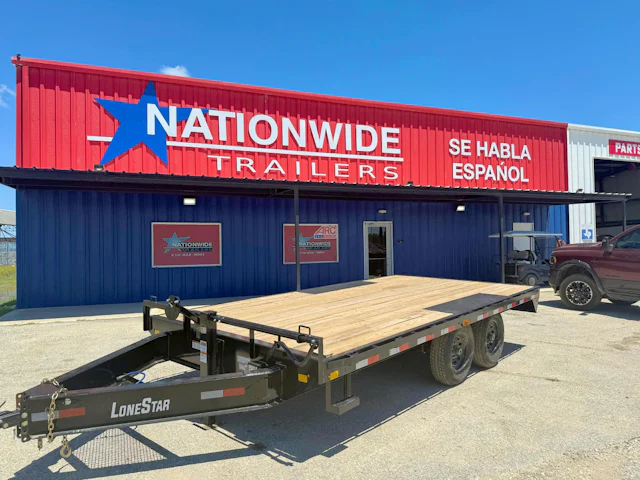
LoneStar 16'x102" Deckover Flatbed Trailer
- 16 ft
- Bumper Pull
- Black
Real Deal™ Price
$6,999
5 ready today at 5 locations

Don't see the right hotshot trailer? 168 are available for delivery from 14 stores in TX, OK, AR, MO & AZ. Get a delivery quote →
$0 down · same-day approval Soft credit check, no hit to your score. All credit levels welcome.
Pre-qualify →Before you buy
Shop live hotshot trailer inventory first, then compare the specifications of the trailers that fit your route and budget. Hotshot trailers are commonly used for time-sensitive freight, construction materials, farm and ranch loads, vehicles, and equipment. The right setup depends on the cargo, loading method, securement plan, tow vehicle, and operating requirements.
Use each live listing as the source for that trailer's dimensions, ratings, equipment, price, and location.
Map the trailer to the work: time-sensitive freight may prioritize usable deck length and tie-down access; construction and equipment hauling may depend on concentrated-load support and loading angle; vehicles need tire-path and clearance checks; hay and agricultural loads need suitable deck space, distribution, and securement. Confirm that the exact trailer is designed and rated for the planned cargo.
Compare GVWR, labeled or actual empty weight with options, available payload, axle and tire ratings, and usable main- and upper-deck dimensions. Overall trailer length is not the same as usable deck space. Account for attachments, pallets, tools, overhang, concentrated loads, and room for cargo control.
Verify the exact hitch or gooseneck configuration, turning and cab clearance, pin or tongue weight, tow-vehicle ratings, brake equipment and controller requirements, tires, load distribution, and the completed truck-and-trailer combination. CDL, registration, authority, insurance, and operating rules depend on the ratings, use, cargo, route, and jurisdiction—not the trailer name alone.
Compare deck height, approach and breakover angles, side-loading access, ramps, dovetails, hydraulic tails, winch provisions, rub rails, stake pockets, and rated tie-down points. Check the ratings and instructions for every ramp, tail, securement point, and loading system on the selected model.
Use the exact listing and manufacturer specifications to compare frame and torque-tube design, steel construction, axles and suspension, finish, deck condition, LED or deck lighting, steps, toolboxes, jacks, winch hardware, and loading equipment. Features such as wide ramps, self-cleaning dovetails, sliding winch ratchets, and extra toolboxes are trailer-specific options, not standard on every hotshot trailer.
Hotshot commonly describes a freight-hauling use, flatbed describes the open deck, and gooseneck describes a pull configuration; one trailer can fit all three descriptions. CDL and non-CDL are operating and combination considerations, not guaranteed trailer features. For each available trailer, compare the listed price and location, condition, GVWR, empty weight and payload when provided, usable deck dimensions, axle and tire ratings, hitch type, brakes, loading system, tie-down layout, installed options, and warranty information. Ask the selling dealership to verify equipment and availability before purchase.
A hotshot trailer is generally an open-deck trailer configured for hauling freight with a pickup or similar tow vehicle. Deck layout, pull type, length, axles, loading equipment, and ratings vary, and legal or operating requirements depend on the complete combination and how it is used.
Hotshot trailers are commonly considered for commercial freight, construction materials, farm and ranch loads such as hay, vehicles, and equipment. Suitability depends on the exact cargo dimensions and weight, loading method, distribution, securement, trailer ratings, and tow vehicle. A trailer specialist can help compare live listings, but the buyer and operator remain responsible for a compliant setup.
Read verified customer reviews by location to evaluate dealership experiences such as selection, communication, buying support, parts, and service. Reviews reflect individual customer experiences; confirm current inventory, pricing, options, and service availability directly with the selling store.
Start with GVWR, empty weight and available payload, usable deck dimensions, axle and tire ratings, hitch type, brakes, loading angle, ramps or tail, and rated securement points. Then compare trailer-specific equipment such as torque tubes, lighting, steps, toolboxes, jacks, winch hardware, and finish. Verify every feature on the exact listing.
Compare advertised prices on live inventory along with the exact model, condition, ratings, installed options, location, and warranty information. Current deals, financing programs, manufacturer offers, fees, and eligibility can change and may apply only to certain stock numbers or stores, so confirm the complete purchase terms with the selling dealership.
Open a live inventory listing to see its current store, price, specifications, and contact options. Submit the listing's quote or purchase form, or contact that dealership and reference the stock number. A trailer specialist can verify availability and equipment, discuss financing, and explain available pickup or delivery options for that trailer.


