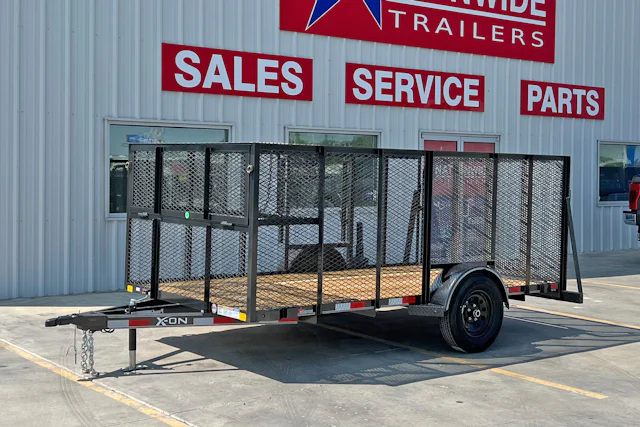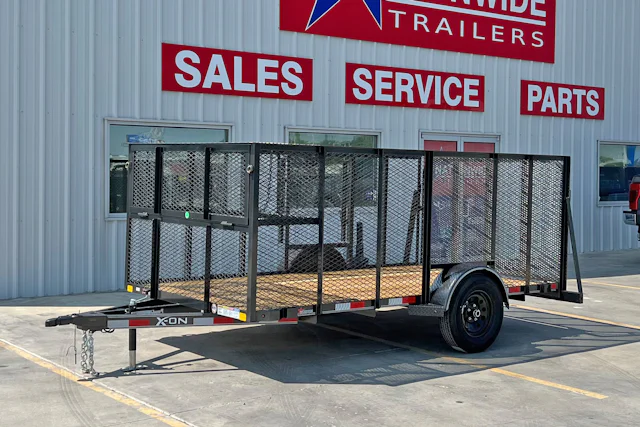

Texas Bragg 12'x77" Landscape Trailer (LST) (12LST)
- 12 ft
- 2,995 lb GVWR
- Bumper Pull
- Black
Real Deal™ Price
$3,249 – $3,749
15 ready today at 7 locations

Don't see the right landscape trailer? 186 are available for delivery from 14 stores in TX, OK, AR, MO & AZ. Get a delivery quote →
$0 down · same-day approval Soft credit check, no hit to your score. All credit levels welcome.
Pre-qualify →Before you buy
Start with live landscape trailer inventory, then compare exact trailers around the full equipment list and daily route. Landscape trailers can support lawn care, grounds work, property maintenance, cleanups, material transport, and appropriate ATV or UTV hauling when the deck, sides, gates or ramps, payload, securement, and tow vehicle fit the complete load.
Plan the layout around what travels together, how often each item is reached, and the conditions at every stop.
List the mowers, compact equipment, hand tools, materials, attachments, and containers that travel together for business or personal use. Record their combined weight and footprint, loading order, frequency of access, and space needed for distribution and securement. Confirm that the exact trailer is designed and rated for each planned load.
Measure usable deck width and length, space between fenders or rails, opening width, side height, and clearance for mower decks, tires, tracks, or attachments. Open rails, tube or pipe tops, mesh sides, high side rails, removable sections, and wood or other deck materials change containment, access, empty weight, and maintenance. Verify construction and dimensions on the exact trailer.
Rear landscape gates, split or spring-assist gates, swing-up gates, side gates, and separate ramps change loading effort, clearance, and access. Check opening width, ramp length and rating, approach and breakover angles, traction, mower-deck clearance, and how the gate is raised, lowered, stored, and secured. Side ATV or UTV loading requires an exact fit and rated loading path.
Single-axle models may fit smaller, lighter routes, while tandem-axle models are commonly considered for larger decks or heavier recurring loads. Axle count alone does not establish safety, stability, payload, or towing fit. Use the exact GVWR and documented empty weight to determine available payload, then verify axles, tires, brakes, load distribution, tongue weight, coupler, hitch, tow-vehicle ratings, and securement.
Tool racks, trays, lockable boxes, side extensions, jacks, couplers, lights, wiring, and gate-assist equipment are trailer-specific. Confirm ratings, installation, access, and security before adding equipment. Follow the manufacturer’s inspection and service schedule for the structure, deck, securement, tires, bearings, axles, brakes, hinges, gates, lights, wiring, and fasteners; use replacement parts verified for the exact model.
Landscape and utility trailers overlap, but landscape configurations commonly emphasize repeated equipment access and organized route work. A single-axle open-rail model may fit a smaller mower-and-tool setup; tandem axles, larger decks, high or mesh sides, and added storage may suit different loads and workflows. Rear landscape gates, split gates, side gates, ramps, and removable sections solve different access needs. A general utility trailer may be the better fit when cargo and loading methods change frequently. Before buying, verify the exact condition, price and location, usable deck and opening dimensions, GVWR, documented empty weight and payload, axle and tire ratings, brakes, hitch, deck material, rails or sides, gate or ramp rating, securement, installed options, warranty information, current availability, and vehicle-manual limits. Confirm financing, fees, inspection, paperwork, pickup or delivery, parts, and service details with the selling dealership.
The categories overlap, but landscape models often focus on repeated equipment loading, route-ready access through rear or side gates, and storage provisions for tools. Utility trailers cover a broader range of open-cargo jobs. Compare the exact deck, sides, gates, axles, payload, storage, and equipment fit rather than relying on the label.
Lay out the complete equipment list using actual dimensions and loaded weights, then allow room for loading, access, balance, and securement. Verify usable deck dimensions, gate opening and angle, fender clearance, payload, and towing equipment on the exact trailer.
Choose around the complete load, deck size, route, operating conditions, service needs, and tow vehicle. Single-axle models may suit smaller and lighter setups; tandem-axle models are commonly evaluated for larger decks or heavier recurring loads. Compare the exact GVWR, empty weight, payload, axle and tire ratings, brakes, and manufacturer specifications rather than choosing by axle count alone.
Compare usable deck and opening dimensions, deck material, open or high rails, tube or pipe tops, mesh sides, rear or side gates, ramps, gate assist, securement points, tool racks or lockable storage, jack and coupler, lights and wiring, axles, tires, and brakes. Features and ratings vary by model, so verify what is installed on the exact listing.
Compare live listings by exact model, condition, dimensions, GVWR, empty weight and payload when provided, axles, tires, brakes, sides, gates, storage, location, advertised price, and warranty information. Reviews can help evaluate customer support, but inventory, deals, financing, fees, inspection, delivery, parts, and service capabilities vary. Ask the selling store to verify complete terms before purchase.
Follow the manufacturer’s schedule and inspect the structure, deck, securement, tires, wheels, bearings, axles, brakes, hinges, gates or ramps, lights, wiring, jack, coupler, and fasteners. Clean dirt, debris, and corrosive material as directed. Replacement axles, brakes, lights, hinges, gate-assist parts, and accessories must be compatible with the exact trailer model and installed as specified.