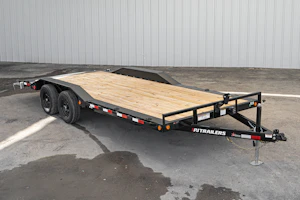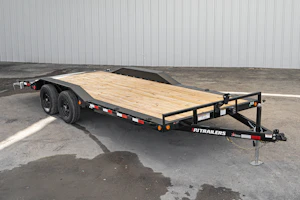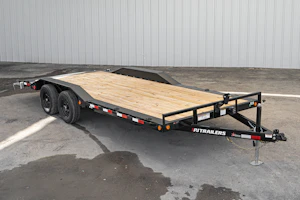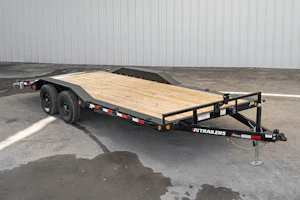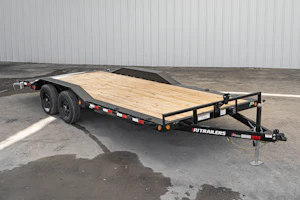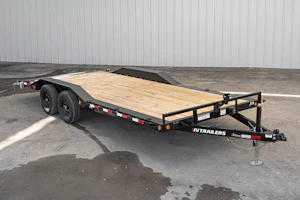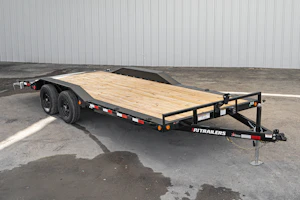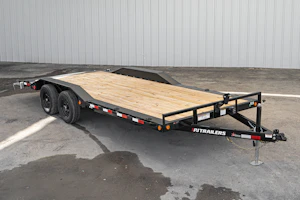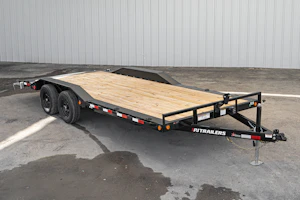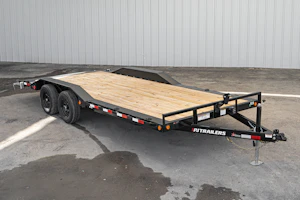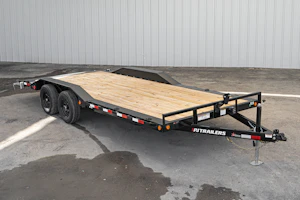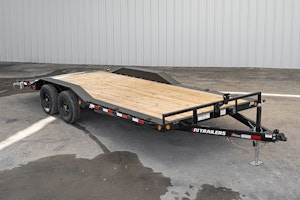
Condition:New
GVWR:9899
Length:20ft
Width:102in
Tail:2' Dovetail
Black
Your Price:$6,799

The car is already yours — the auction find, the project, the truck that quit two towns over. A car trailer's whole job is the ride home: 176 car haulers in stock across 14 stores in Texas, Oklahoma, Arkansas, Missouri & Arizona, sorted above by axle rating, deck material, and length.
Start from payload, not the rating sticker. A car hauler's GVWR includes the trailer itself — an 18-foot steel deck weighs roughly 2,000–2,500 lbs empty — so a 7,000-lb-rated trailer really carries about 4,500 to 5,000 lbs of car. That covers a Miata (about 2,350 lbs) twice over, and nearly every sedan and sports car rides the same math. A modern muscle car at 3,800–4,400 lbs still fits, with less margin than it looks like. A crew-cab half-ton pickup runs around 5,500 lbs — that load walks straight past the 7k trailer and lands on the 14,000-lb decks, which carry a full-size truck with weight left over. Our shelf clusters at exactly those two answers: ratings between 7,000 and 10,000 lbs for cars, and 14,000 lbs for trucks and heavy iron. Buy for the heaviest thing you'll ever load, not the car in this weekend's plan.
Both do the work; they age differently. Treated wood gives tires bite in the rain, soaks up a leaky oil pan instead of turning slick, and when a board finally gives out you replace the board, not the deck. Steel shrugs off what wood can't — a dead car dragged up on a winch cable, a chain hook dropped from waist height — and it hoses clean at the end of a muddy day. If the trailer earns money every week, steel takes the abuse; if it hauls your own cars a dozen times a year, wood is easy to live with. Aluminum is the third path: no rust, hundreds of pounds less trailer to tow, more money up front — Aluma builds most of the aluminum car haulers we stock. And if the car needs to travel out of the weather entirely — fresh paint, an open winter route — that's an enclosed hauler, which lives with our enclosed cargo trailers.
The gap between the plainest car hauler on the lot and the most expensive one isn't the frame — it's the equipment. A dovetail, a winch-mount plate, heavier axles, extra deck length, and the steel-or-wood call each move the number, so a bare 7k wood deck and a loaded 14k steel deck are different tools at honestly different prices. Altogether the range is $3,400 to $17,900, and most of it sits in the lower half. Financing and rent-to-own both work here, and the paperwork does its math in the open — full term, real rate, and what you'll actually have paid when the note ends, all on paper before you sign. If the trailer is a tool for making money, judge it by the note's total against the work, not the payment against the month.
Prices on this page are cash prices before tax, title, and the doc fee — three lines your state has a say in. Before you settle on a number, have the store quote the trailer out the door. That's the honest bottom line.
Ramp angle is the whole problem. Short ramps meeting a flat deck make a breakover a lowered nose can't clear, and creeping up slower doesn't change the geometry. What does: a dovetail, which angles the tail of the deck down toward the ground, and longer ramps, which stretch the same climb over more distance — together they flatten the approach enough for the front lip and the exhaust to arrive whole. Planks under the ramp feet buy a few more degrees for the truly low stuff. And a tilt trailer deletes the ramps altogether — the deck itself pivots into one continuous slope — which is why lowered-car owners keep ending up on our tilt trailers page.
A dead car is a loading problem, not a hauling problem — once it's strapped down, the trailer neither knows nor cares. The tool is a winch bolted to the trailer's mount plate: transmission in neutral, cable to the frame or a tow hook, and walk it up the ramps with somebody in the seat to steer. Tie-down works the same either way — four points, one at each corner, pulling against each other — and every strap gets checked at the first fuel stop, because new straps stretch. If flips or recovery work is the plan, order the winch mount on the trailer from day one and put it on a steel deck.
One call to (866) 606-7477 with the make, the rough weight, and whether it runs gets you the right axle rating and the nearest store that has it in stock.